
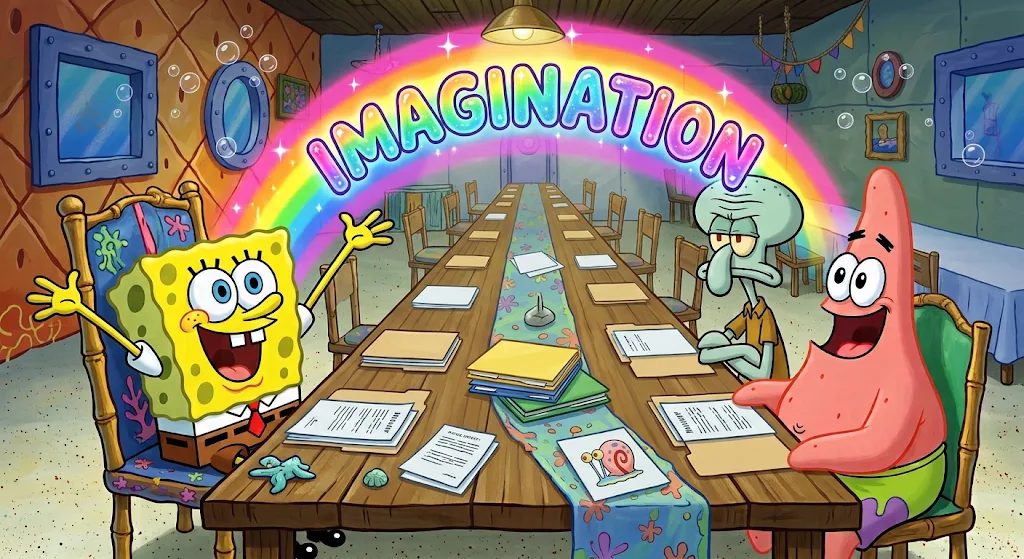
In The Idiot Box, Squidward watches SpongeBob and Patrick receive a huge TV in a giant box, then throw out the TV and climb into the box, one assumes to play. He asks SpongeBob if he can keep the TV, and SpongeBob says yes, he can. As Squidward walks away carrying his new prized possession, he is stunned to hear real-life sounds, like avalanches and police sirens, emanating from the box. He pulls open the box, but all he sees is SpongeBob and Patrick sitting and giggling inside. He demands that they tell him how they made those noises, at which point, after Patrick gets up and says that “…all you need is a box.” SpongeBob stands up, holds both his hands in front of his face, palms out, and slowly separates them, forming an arc. At the same time, a rainbow appears between his hands as he says, “…and IMAGINATION”
Mediators must use their imagination every day as they dig deeper into the detritus of other people lives, looking for a clue that will cue the disputant’s own imaginations, gently urging them to consider possibilities they had heretofore not contemplated. The mediator too, while parachuting into these acres of pain, must open themselves up to the new worlds they are encountering for the first time. Being unbiased doesn’t just mean not being allowed to take sides. It’s also about getting out of your own way and letting the new colors and shapes of other people’s lives arrive into your consciousness unvarnished by your own life experiences. That is why it is dangerous to reveal bits of yourself during a mediation in an unguarded moment, by saying “ Oh yeah. I’ve been there.” Or words to that effect. Aside from the fact that the comment itself might be silently interpreted by either side as showing bias, it indicates that the mediator is dragging the moment into their own field of reference rather than allowing themselves to have their horizons widened by allowing the possibility that they have not experienced the moment just like their client. It behooves the mediator to stay silent and listen at those moments for a special emphasis or an obscured allusion that might suggest a whole world of previously unknown choices.
If life is about perspective and choices, and I happen to think that it is, then that holds especially true for mediators, and actors. As I have been both, I can comment with first-hand experience when, as an actor, you are asked to rehearse yourself into the heart and soul of another person, you have to get out of your own way, and allow the character to be drawn on you, like a tabula rasa, or white board. When you try to bend the character to be more like you, sound more like you, you are, quite simply, not doing your job. After all, other people’s lives are generally more interesting and fascinating then yours, if you think about it. Why then would you want to make them more like you? It is far better to follow their trains of thought all the way to their destination, gathering bits and pieces that can be used to build a character that more likely mirrors the playwright’s intentions rather than your own limitations.
By thinking of themselves at that moment of opportunity, the mediator may have missed their chance to move their clients onto a path they never considered, but that may yet take them to their own highly specific promised land.
Or at least a giant box.